1.
Is there a more conservative treatment
available that does not include surgery?
Yes, prescription medications
and iontophoresis are conservative treatment modalities that
should be tried before considering surgery.
A group of medications (Ditropan, Robinul, Propantheline) known
as anticholinergic agents may be effective in reducing excessive
sweating. These
medications act to block neurotransmission of acetylcholine which
has a function in sweat production. These have limited
effectiveness as the body can develop a resistance to the medication.
Iontophoresis
(Drionic, Hydrex) has been reported to be effective at treating
the hands, underarms and feet. If
antiperspirants are not effective, iontophoresis may be a good
option to explore. More about Iontophoresis:
Used to
treat palmar, axillary, and plantar hyperhidrosis.
Low intensity electric current (15-18
mA) applied to the palms and/or soles immersed in an electrolyte
solution.
Has to be repeated regularly, initially
in 20 minute sessions several times/week, gradually stretching
out the interval between treatments to 1-2 weeks. The results
vary: many patients (70%), suffering from light to moderate
hyperhiderosis, are happy with the method, some may consider
it too time-consuming or inefficient and comparably expensive.
It is difficult to apply in axillary, and impossible to use
in diffuse hyperhidrosis of the face or the trunk/thigh region.
Side
effects include: burning, electric shock, discomfort, tingling,
skin irritation (erythema
and vesicle formation).
Sweating returns after cessation.
2.
Is clamping as effective as cutting the sympathetic nerve at
the T2 level?
It depends on:
a) if any Kuntz nerve are
present (if so they need to be addressed too) and
b) whether the metal
clamp stays fully across the nerve and doesn't become
dislodged.
3.
Do clamps have any side effects associated with their placement
in the chest?
Inflammation
of the tissue, a neuroma, surrounding the nerve clamped can develop
as the body reacts to the placement of a foreign object. Foreign
body reactions to clamps may cause pain, recurrent symptoms and/or
new symptoms to develop.
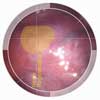
(CLICK IMAGE
AT LEFT TO ENLARGE. ROLL MOUSE OVER ENLARGED PICTURE TO
VIEW CLAMPS AND RESULTING NEUROMA)Click
to compare Micro ETS to Clamping
TOP
4.
Is ETS efficacy and the chance of developing more intense compensatory
sweating that different between surgical techniques?
When comparing efficacy of one ETS technique
to another it is important to look at:
a) whether the Kuntz nerves are dealt with when present
b) how the nerve is found and then divided (by dissecting the
surrounding tissue away from the nerve just to find it can
lead to more postop pain and may increase the chance of developing
Horner's syndrome)
c) whether only the T2 level is divided or clamped rather than
multiple levels
d) the number of incisions, but just as important is the size
of the incision (intercostal space between patients can vary
in width, with the risk of developing chronic neuralgia (pain
and numbness) greater the larger the instrument that is used.
Small females for instance, have a narrower intercostal space
making the risk of developing chronic chest wall neuralgia
greater the larger the instrument that is used and if more
than one incision per side is used.
5.
Does dividing only one sympathetic nerve level (the T2 level)
and not removing any length of nerve nor the nearby ganglion lead
to less compensatory sweating?
Yes. When comparing ETS techniques, it is important
to look at:
a) whether the nerve is precisely cut and not handled as it is
looked for
b) not disturbing the nearby ganglion
c) not removing nerve with ganglia attached
d) not having many levels cut as this may lead to more intense
compensatory sweating
e) making sure that any Kuntz nerves present
crossing the second rib are divided or clamped, otherwise persistent
or even recurrence of symptoms may occur.
Watch
Video - At What Level Do You Perform Micro ETS and Why?
6. What
is the importance of Kuntz nerves and what exactly are they
responsible for?
Kuntz
Nerves Stats - Kuntz nerves are small nerve
branches from the sympathetic nerve trunk most commonly arising
at or around the T2 level. Sometimes they are present
at the T3 and T4 levels as well. They bypass the level they
are at and therefore can continue to carry nerve signals
past a severed or clamped sympathetic nerve trunk. Kuntz
nerves are
present in approximately 50% of individuals with
one report being as high as 63%. In my experience,
Kuntz nerves are present in at least 80-90% of individuals.
I've found as many as seven small Kuntz branches in one patient.
If these small nerve branches are not cut where they cross
the second rib, then persistent hyperhidrosis and/or Raynauds'
symptoms can occur. Return of symptoms after a sympathectomy
even can be interpreted as "nerve regeneration or reconnection" several
months after surgery.
7.
Why is it important not to remove or injure any sympathetic
ganglia?
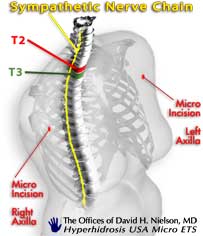
Sympathectomy by removing a segment of nerve along
with the attached ganglia can lead to more intense compensatory
sweating and more postoperative pain as well. The ganglia are
interconnected from one level to another and disturbing any of
these connections can interfere with the modulatory effects they
have on the entire sympathetic nerve chain.
Click to Enlarge
8.
Why have people come to you to have a redo with Micro ETS™ surgery?
Some individuals have come to me with persistent
symptoms (sweating for example) after having had ETS surgery
performed by someone else. I have treated them with redo ETS
successfully and discharged them the same day despite undergoing
a redo procedure. I have found the cause(s) to be hidden sympathetic
nerve/ganglia under thick tissue making it easy to have been
missed the first time, and intact Kuntz sympathetic nerves crossing
the second and/or third rib(s)! Partial nerve
regeneration has also been found in many redo surgeries
by Dr. Nielson.
Watch
Video - Why Have People Come for Micro ETS Redo?
9. Do insurance companies cover Micro ETS™ surgery?
My office staff personally speaks with each insurance
company helping them to see why hyperhidrosis really is a medical
condition impairing one's life in many ways and not just a cosmetic
nuisance.
10.
Is Micro ETS™ as effective as other treatment modalities
for moderate to severe hyperhidrosis?
Treatment
of choice for severe hyperhidrosis because:
Dramatic
improvement (extremely high success rate for
palmar involvement for example)
Less expensive treatment than life-long medical treatments,
and/or other surgical or radiological approaches.
Extremely low complication rate and morbidity (NOT all techniques
are the same!)
Rapid return to full functional status.
1 to 3 days for school/work
2 weeks for full physical activities.
11.
Is Micro ETS™ an approved procedure by the FDA?
Yes, the instruments and equipment are FDA approved.
12.
Is "Single
Micro Incision" ETS an experimental procedure?
No, my "Micro Single Incision" ETS technique
evolved by applying new state-of-the-art technology to invasive
thoracic sympathectomy of the past which has been done for decades.
Now, through single "Micro Incision" ETS, what was
once considered to be extremely invasive surgery reserved only
for the most severe cases (severe Raynaud's or Causalgia for
example), is available to and curative for the many individuals
today who are plagued by symptoms of over-active sympathetic
nerves with very low post-op morbidity.
13.
How long is the incision?
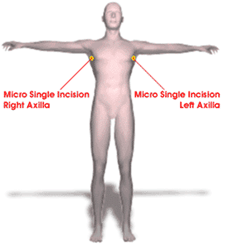
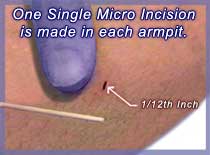
I only make a single
1/12th inch (2 millimeter) incision in the axilla
(armpit). Working through this micro incision usually affords
my patients much less post-op discomfort . No sutures are
needed. The scar produced is extremely small and almost painless.
Both the right and left sides are done at the same time.
14.
Do you participate in insurance plans?
My hyperhidrosis
office bills your insurance company directly. A deductible
is required up-front in many cases. Visa/Mastercard, American
Express & Discover Cards are accepted.
15.
Do the symptoms associated with hyperhidrosis recur once Micro
ETS™ has been performed?
No, except
in a few cases. Recurrence is possible if:
1) Kuntz nerves are missed during surgery (parallel
nerves which bypass the sympathetic ganglia).
2) Incomplete division of the sympathetic nerve chain.
Serious complications
from the surgery are unusual.
Sensitive pleurae (chest lining
sensitivity) can limit exercise, Horners Syndrome, which is rarely
reported, pneumothorax (collapsed lung), bleeding, postop neuralgia
and parasthesias, possible hair loss, and bradycardia (slow heart
rate) possibly requiring a pacemaker. Other possible complications
include, but are not limited to, subcutaneous emphysema, possible
conversion to open thoracotomy and heat intolerance.
Possible
persistence of symptoms can occur if accessory nerve branches
are present, duplicate nerve or aberrant nerve tracts are present.
Recurrence of symptoms can occur if nerve regeneration occurs
(unusual), which could necessitate a need for a redo operation.
Death has been reported in some ETS patients in the world literature.
21.
What contraindications are there to undergoing Micro ETS™?
Prior thoracotomy - relative contraindication.
Severe cardio-circulatory or pulmonary insufficiency.
Severe pleural diseases (empyema, pleuritis).
Untreated hyperthyroidism.
Patients
should be aware that compensatory sweating can and does occur.
Compensatory sweating is experienced as excessive sweating on the back, thighs,
stomach, axillae, groin and/or lower legs and may range from mild to severe.
Reported incidence of developing compensatory sweating in world literature range
between 50% to 90% of all patients undergoing the ETS procedure. Of this group,
it has been reported that about 5% - 10% of these patients experience severe
compensatory sweating. Severe compensatory sweating, or severe compensatory hyperhidrosis,
can be very troublesome, especially when it soaks through clothing. This can
be more problematic in hot humid climates and can become more of a problem than
the original problem treated.
The tolerance of compensatory sweating is patient dependent. Some patients tolerate
severe sweating while others do not tolerate even mild compensatory sweating.
There are medications that may help lessen the severity of compensatory sweating
post operatively.
Overweight patients may experience more compensatory sweating and those who live
in hot, humid climates may find it less tolerable. Compensatory sweating is the
most common side effect reported by patients regardless of which surgeon is performing
Micro ETS.
Gustatory Sweating, which occurs while eating or smelling certain foods, can
develop post operatively in about 10 to 20% of the patients.
Phantom sweating occurs in some patients after ETS surgery (feeling the sensations
of sweating but not actually sweating) and typically resolves in 1 to 3 weeks
after surgery.
23.
Do surgeons who perform Micro ETS™ use the same technique?
No! A few surgeons use only one
(1")
incision per side while others use 2 to 4 incisions per
side. I use a single 1/12th inch (2 millimeter) incision
in the axilla. I call this "Micro Single Incision"ETS.
24.
How experienced is Dr. Nielson as an ETS surgeon?
Dr.
Nielson has performed over 7000 procedures with
his 1/12th inch single incision Micro ETS technique.
Few other surgeons have performed as many truly minimally invasive
surgeries making Dr. Nielson perhaps the most experienced minimally
invasive ETS surgeon in the world.
For special arrangements, please contact Dr.
Nielson's office staff with any questions. All
patients receive a pre-operative consultation with Dr. Nielson.
26. What if my only concern is underarm sweat and odor,
how effective is Micro ETS?
Please contact Dr. Nielson to discuss
Micro ETS to stop underarm sweating.
27.
What do Patients say about how stopping excessive sweating dramatically CHANGED their lives!
Patients share what life is like after sweating improved.
28.
Does Dr.
Nielson collapse the lungs during the surgery?