Endoscopic
Thoracic Sympathectomy (Micro ETS) - Ganglion-Sparing, Less Traumatic
Surgery Technique.
Endoscopic Thoracic Sympathectomy Micro ETS surgery is a treatment option
for Hyperhidrosis
(facial, head, hands, underarms),
facial blushing, vascular disorders (Raynaud's Syndrome), causalgia
(RSD), and migraine headaches.
Introduction Hyperhidrosis is present in
0.6 to 1% of the population. The sympathetic nervous system is
overactive in these people at inappropriate times (low stress conditions,
sitting quietly, cool surroundings, etc) causing excess sweating
of the hands, armpits, face, scalp, and sometimes feet.
Today, the treatment
of choice for severe hyperhidrosis is ETS. Fortunately today,
for patients afflicted with excessive sweating of the hands,
face, underarms, feet, Raynaud's Disease, embarrassing blushing,
or Causalgia, there are a few surgeons around the world who are
experienced with this minimally invasive technique. Many
individuals can now be treated surgically with improvement of
symptoms from hyperactive sympathetic nerves with minimal cost
and morbidity, rather than just receiving repeated life-long
treatments which are palliative at best.
Micro ETS was developed by Dr. Nielson by applying
new state-of-the-art technology to invasive thoracic sympathectomy
of the past which has been done for decades. Now, through a single-incision
ETS, what was once considered to be extremely invasive surgery
reserved only for the most severe cases (severe Raynaud's or Causalgia
for example), is available to and highly curative for the many
individuals today who are plagued by symptoms of over-active sympathetic
nerves.
Benefits of "Micro Single Incision" ETS
ETS surgery results are curative immediately.
Patients
leave the operating room with dry scalp, face, hands, armpits.
Single-Micro Incision technique
(1/12th Inch Incision) “Ganglion
sparing, less traumatic".
No sutures required.
Much
less postop pain.
High success rate.
FDA
approved instruments/equipment.
Same day surgery (discharged
the same day means lower cost).
Not an experimental procedure.
Latest technology applied to decades-proven invasive (open)
sympathectomy.
Precise visual localization and
transection of the ganglia of interest. Dr. Nielson has
found over the years that by sparing the ganglia, side effects
may be less likely.
Less morbidity than by other approaches such as; Through
the back. Above the clavicles. A long incision with rib resection.
Through 3 or 4 incisions. Rapid return to full functional status
usually two to three days for school/work and one week for full
physical activities. Improved occupational/professional and social
interactions. Sympathetic ganglia are located along both sides
of the spine. The removal or destruction of some of these ganglia
has been done for decades to treat micro circulation disorders
of the hands and feet and hyperhidrosis. Today, Micro ETS is the
method of choice to treat severe hyperhidrosis involving the scalp,
face, hands, and axillae. Also, it is effective in improving facial
blushing which may cause social embarrassment.
Technique
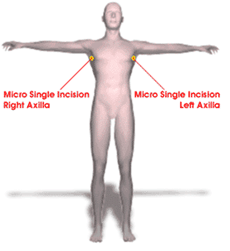
Micro ETS is done in an ambulatory
surgical center. Both sides are done at the same time. General
anesthesia is required. The lungs are NOT collapsed. Only
one micro incision (1/12th inch in length) is made along the outer
aspect of the pectoralis major muscle in the axilla (arm pit) in
the third intercostal space. A 1/12th inch endoscope is inserted
through the Micro chest incision into the thoracic cavity.Identification
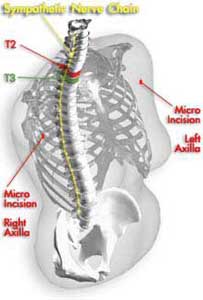
of the sympathetic nerve and any Kuntz nerve branches is done.
One thoracic ganglion level is isolated by cutting the sympathetic
nerve precisely as it crosses the second rib. The divided ends
are cauterized using a low current to minimize nerve reconnections.
For axillary hyperhidrosis two ganglia levels are precisely isolated
by cutting the sympathetic nerve and any Kuntz nerve branches
as they cross the second, third and, fourth ribs for a T2-T3 sympathectomy.
The nerves and ganglia are not removed with this technique. The
ganglia are left attached to the spinal cord with preservation
of the interganglionic connections. This helps to lessen compensatory
sweating and post-op pain.
A topical
skin adhesive is used to close the tiny single incision. Upon completion
of the right side, the left side is then done in similar fashion.
A chest X-ray is taken and the patient discharged a few hours later
with a follow-up exam in the morning. The patient then returns
home.
Normal activities can resume a few days later and
full physical activities in one to two weeks. Whether unilateral
or bilateral sympathectomy is performed depends on the patient's
and surgeon's preoperative plan. Dr. Nielson usually
performs bilateral sympathectomies at the same sitting.
Watch
Video - Hand Sweat Treated for Young Female Patient
Results
After the sympathetic
nerve has been cut at the second rib level in the operating room,
the skin of the hands, face, and scalp becomes dry. This change
occurs in the operating room. While many of our patients experience
continued dryness, in some instances patients report that within
3-6 months post op there is an onset of compensatory sweating.
Talk to your doctor about compensatory sweating and other complications
of the procedure before participating in any surgical program so
that you can determine what is best for you and your condition.
Patients report that following surgery, scalp and facial blushing
subside and cardiac reactions to stress (increased heart rate)
is moderated but not completely eliminated. Stage fright response
is substantially reduced. Hyperhidrosis of the feet even improves
in some cases, but this effect is less predictable. Continued significant
reduction in sweating of the hands, face and scalp has been reported
but we have seen in some patients the ability of the nerve to regenerate
as early as one year and as late as ten years after sympathectomy..
Some patients report a return of slight sweating during exertion
one or more years after sympathectomy and often describe it as
“normal” sweating. Due to anatomical differences of nerve pathways
in some patients, intact nerve fibers may remain following sympathectomy
which could lead to persistent symptoms.
Immediate post operative
skin dryness, improvement in blushing, warming of fingers. High success
rate for:
Palmar hyperhidrosis
Scalp and facial sweating
Facial blushing & facial hyperpyrexia
Raynaud's (condition recurs over time)
Dr. Nielson’s Micro
ETS technique is less invasive because the T2 ganglion is not
disturbed in any way. He has found over the years that by sparing
the ganglia, side effects may be less likely. ETS procedures
may differ in technique and invasiveness, therefore efficacy,
side effects, complications and recovery time may similary vary.
Known
Side Effects
Patients
should be aware that compensatory sweating can and does occur.
Compensatory sweating is experienced as excessive sweating on the
back, thighs, stomach, axillae, groin and/or lower legs and may
range from mild to severe. Reported incidence of developing compensatory
sweating in world literature range between 50% to 90% of all patients
undergoing the ETS procedure. Of this group, it has been reported
that about 5% - 10% of these patients experience severe compensatory
sweating. Severe compensatory sweating, or severe compensatory
hyperhidrosis, can be very troublesome, especially when it soaks
through clothing. This can be more problematic in hot humid climates
and can become more of a problem than the original problem treated.
The tolerance of compensatory sweating is patient dependent. Some
patients tolerate severe sweating while others do not tolerate
even mild compensatory sweating. There are medications that may
help lessen the severity of compensatory sweating post operatively.
Overweight patients may experience more compensatory sweating and
those who live in hot, humid climates may find it less tolerable.
Compensatory sweating is the most common side effect reported by
patients regardless of which surgeon is performing Micro ETS.
Gustatory
Sweating, which occurs while eating or smelling certain foods,
can develop post operatively in about 10 to 20% of the patients.
Phantom sweating occurs in some patients after ETS surgery (feeling
the sensations of sweating but not actually sweating) and typically
resolves in 1 to 3 weeks after surgery.
Contraindications
Prior thoracotomy - relative contraindication.
Severe cardio-circulatory or pulmonary
insufficiency.