 |
Hyperhidrosis USA - Micro ETS | Call (877) 837-9379 Toll Free info@dhnmd.com Email | The Offices of David H. Nielson, MD |


| PRESS RELEASES |
        |
|
|
 |
|
 |




Surgery Ends Misery of Wet Palms, Feet for Eight Year Old GirlStory
by Beth Reinhardt, San
Antonio Express News
She wore gloves at piano lessons to keep the keys dry. She kept a towel in her desk at school to wipe off her papers. Her tennis racket slipped during lessons because of her perspiration. But what made her cry was that no one wanted to hold her hand. Rachel has hyperhidrosis, a condition that causes excessive sweating.
Her mother, Sarah Walther, knew something was not right. "At age2, I noticed that her socks would be soaking wet and her hands would be sweaty," Sarah recalls. When Rachel was 3 years old, her mother knew the sweaty hands and feet were abnormal, but their pediatrician said she would outgrow it. "Then I saw a '20/20' special on it and, boy, did I bawl. I thought, 'That's my girl, that's my daughter,'" Sarah says. At the time, she did not hear the name, hyperhidrosis, and it was several years later before Sarah found a diagnosis for Rachel. Hyperhidrosis affects 0.6 percent to 1 percent of the population, or about 6,000-10,000 people in San Antonio. It is a hereditary condition caused by an overactive sympathetic nervous system. Symptoms include extreme sweating of the hands, underarm area, face, scalp, or feet. It is associated with Raynaud's Syndrome (cold hands that often change colors because of hypersensitivity to temperature change), facial blushing and Reflex Sympthetic Dystrophy, pain of the hands and arms. Hyperhidrosis causes more than the physical discomfort. With time, it becomes an emotional issue. After seeing the news special, Sarah and her husband, Larry, knew their daughter would be in for a tough time as she got older. Despite not having a diagnosis, they still prayed for a treatment. The first treatment, Drysol, a topical antiperspirant used by athletes, did not work. In the fall of 2000, Sarah asked her prayer group for help. Amazingly enough, a member of the group had just heard a story about hyperhidrosis. Rachel's condition now had a name and a possible treatment. Sarah took the 800 number and put it on her bulletin board. The day Rachel came home from school in tears because no one wanted to hold her hand, Sarah called. "I had no idea the office was in San Antonio," she says. Innovative Treatment Nielson became involved with the treatment for hyperhidrosis in the late 1980's while at Temple University Medical School. At that time, treatment of hyperactive sympathetic nerve dysfunction was very invasive. It involved making a single large incision or four 1/2-inch to 1-inch incisions in the chest, spreading the ribs, severing the nerve and several painful days in the hospital. As technology allowed, Nielson has continuously improved his endoscopic techniques of his heart and lung surgeries, which he used to create the ETS procedure, by making smaller and fewer incisions. During the procedure, Nielson makes a single incision, one-twelfth on an inch per side, under each arm. Nielson inserts a 2 mm scope, camera and micro scissors into the incision. Nielson compares the size of his instruments to angel hair pasta. Once the sympathetic nerve is identified, he severs it, which instantly improves the excessive sweating. The procedure takes 30 minutes. The patient is able to leave two to four hours after the procedure. Rachel is the youngest patient and smallest to have the procedure done. His patients now range from 8 to 75 years old. Emotional
Issues
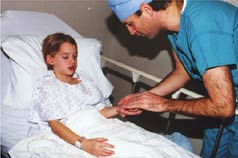
When asked about her sweating, Rachel would become very annoyed. "Every time I'd start to sweat, I'd get so mad. I'd feel like screaming my head off," Rachel says. Many people are misdiagnosed. Dermatologists recommend Botulinum Toxin injections into the hands or Drysol as a treatment. Some patients are told to simply deal with the problem. Patients, especially young patients, are told it is related to puberty. Other patients are told the sweating is a panic attack and are prescribed anti-depressants. Patients suffering from hyperhidrosis - from teens wanting to date but won't due to sweaty hands to adults choosing a career - face a lifetime of emotional problems, Nielson explains. "I can recount stories of patients who have been excluded by classmates," Nielson says, while detailing the emotional pain that hyperhidrosis can cause. Hyperhidrosis affected the lives of 17-year-old Katie Stevens, a senior at MacArthur High School, and 19-year-old Megan Kolenda, a freshman at San Antonio College. "I felt separated from the others," Stevens says. "I was really embarrassed because my hands were so sweaty and I didn't know what was wrong with me." Kolenda agreed with Stevens: "I felt different, and I was always shy. I worried about meeting people or getting my paper wet in school." Although they have never met, Kolenda and Stevens used the same techniques to cover up their sweating. They always wore denim pants because it absorbs the sweat. They were able to wipe their hands on their jeans. Both carried a sweater even in the hottest months, and wore only white or dark colors so that the sweat would not show under their arms. "I saw the reaction on people's face when I would shake their hands and they would have to wipe their hands off," Stevens says. Kolenda says she used stories to cover her sweating by saying she had "just washed her hands." "Dr. Nielson was so nice and comforting," Stevens
says. "He shook my hand then took my hand and rubbed it. He
was not cringing or anything." Please contact us for more information on Raynaud's Disease by calling 1-877-837-9379 toll free or submit a questionnaire. |





FACIAL SWEATING | SWEATY HANDS | SWEATY FEET | ARMPIT SWEATING | | ALTERNATIVE TREATMENT | IN THE NEWS
RESULTS MAY VARY FROM PERSON TO PERSON.
Copyright © 2017 Hyperhidrosis USA. All rights reserved.